
Lift Planning

Lift Planning is an important part of any rigging activity and must be taken seriously before a load is lifted as it will assist in a safe movement of the load and ensure that correct practices and procedures are adhered to.

The main advantages to pre-planning a lift include:

  • (1) minimize or prevent an injury, incident or damage
  • (2) ensure operators and their employer are informed of the particular hazards involved and appropriate controls to utilize during the lift
  • (3) ensures the approprate legislated and industry standards are adhered to

The following information is compliant with ASME P30.1 Planning for Load Handling Activities.
For more detailed information, please refer to the full ASME standard.

Some important definitions the standard uses are as follows;

  • Dynamic Load: forces introduced into the LHE as a result of change in motion.
  • Lift: to move a load vertically or horizontally with the LHE.
  • Lift Plan: information and/or instruction, written or verbal, used in support of a load handling activity.
  • Load Handling Equipment (LHE): equipment used to move a load vertically or horizontally.
  • Qualified Person: a person who, by possession of a recognized degree or certificate of professional standing in an applicable field, or by extensive knowledge, training, and experience, has successfully demonstrated the ability to solve or resolve problems relating to the subject matter and work.
  • Shall: term used to indicate that a rule is mandatory and must be followed.
  • Should: term used to indicate that a rule is a recommendation, the advisability of which depends on the facts in each situation.

An evaluation of a proposed load handling activity shall be performed. Documentation of the evaluation is not required. It is recommended that the evaluation includes a risk analysis. Useful resources include ISO 31000:2009 and ISO 31010:2009. At a minimum, the load handling category should be determined based on review of the following considerations:

Potential Hazards to Persons

(1) if the load handling activity will involve personnel lifting.

(2) if the load will be moved or suspended over areas accessible to the general public.

(3) if the load contains materials immediately dangerous to life and health.

(4) if load handling personnel will be in locations that may be hazardous during the load handling activity (e.g., pinch points, crush points).

(5) if site personnel other than load handling personnel will be in locations that are hazardous due to the load handling activity. This should include consideration of protection provided by existing structures.

Hazards in Proximity to the Work Area

(1) if the load and/or the load handling equipment (LHE) can encroach the prohibited zone of power lines

(2) if there is potential for electromagnetic radiation/radio frequency hazard (e.g., loss of communication, electrical discharge, and shock)

(3) if the load handling activity can cause damage to pipes, lines, tanks, equipment, or products that could create an adverse environmental impact

Complexity of Load Handling Activity

(1) if the load has potential for instability during the load handling activity due to the

  • (a) design or configuration of the load (e.g., shape, load integrity, and sail area)
  • (b) centre-of-gravity of the load relative to the established connection points
  • (c) load weight shift (e.g., liquid filled, swing arms, and moveable parts)

(2) if the load handling activity uses complex load handling methods

(3) if the load handling activity will be performed in proximity to obstructions or in limited clearance areas, including consideration of clearance between the LHE and the load

(4) if the load is to be manipulated (e.g., turned, rotated, and tilted)

(5) if the LHE travels during the lift

(6) if the load handling activity uses multiple LHE

(7) if the load handling activity is unique to or infrequently performed by the personnel involved

(8) if special means or access for attaching and removing rigging is required

Adverse Impact From Environmental Conditions

If the load handling activity could be adversely impacted by conditions such as

(1) effects of wind on the load and/or LHE (e.g., speed, direction, sustained, and/or gusts)

(2) support for the load, the LHE, or both (e.g., ground, rail, girder, structure, foundation, vessel list, and trim)

(3) ambient temperature (e.g., high, low, and range)

(4) surfaces moving relative to one another (e.g., from land to water, or water to land, or water to water)

(5) visibility (e.g., fog, sun glare, lighting, and obstructions)

(6) precipitation

(7) lightning

LHE Capacity and/or Performance

(1) if the load weight is significant compared to the LHE capacity as configured

(2) if factors, such as the following, have the potential to encroach upon maximum capacity of the LHE, as configured, and/or diminish its performance:

  • (a) increased loading due to extraction or removal of a load (e.g., demolition, suction, and friction)
  • (b) dynamic loading (e.g., abrupt starting, stopping, acceleration, deceleration, and abrupt load transfer)
  • (c) line pull
  • (d) brake/clutch/pump settings and/or conditions
  • (e) accuracy of load weight information/determination
  • (f) site conditions 
  • (g) potential load shift during load handling activity
  • (h) weight distribution or transfer between multiple LHEs
  • (i) effects of moving to/from liquids (current, buoyancy)
  • (j) out-of-plane loading
  • (k) equipment history or condition

Rigging Capacity and/or Performance

If factors, such as those listed in LHE Capacity and/or Performance, and/or the following, have the potential to encroach upon maximum capacity of the rigging, as configured, and/or affect its performance:

(1) rigging attachment points of the load (e.g., lifting lugs, precast inserts)

(2) side loading of the rigging hardware and attachments

(3) complexity of rigging

(4) weight distribution or transfer of load within the rigging arrangement

(5) environmental conditions (e.g., temperature or chemically active environment)

Adverse Commercial Impact

(1) if the load has a significant replacement time

(2) if the cost of replacing the load is considered significant or the load is irreplaceable

(3) if failure to complete the load handling activity could create a project delay, work shutdown, or disruption to the general public

(4) if the load handling activity can cause damage to pipes, lines, tanks, equipment, or products that could create an adverse commercial impact

Site Requirements Unique to the load handling Activity

(1) corporate considerations/policies

(2) regulatory considerations [e.g., local, state, federal, DOT, railroad (FRA), FAA, and military]

(3) potential impact to vital infrastructure (e.g., public utilities, roadways, seaports, pipelines, and railroads)

Repetitive Lifts

(1) distractions, fatigue, inattention, or lack of concentration of the load handling personnel

(2) the LHE and rigging equipment manufacturer’s recommendations for duty cycle or repetitive operations

The decision to use a standard lift plan should be based on the considerations outlined in “Load Handling Activity Considerations”, The lift director should determine that none of these considerations would cause the load handling activity to be recategorized.

Prior to the load handling activity, the lift director should verify that the standard lift plan has been developed. The standard lift plan can be written or verbal. See “Forms” for an example of a lift plan template, a rigging data sheet, and for guidance on establishing a limiting wind speed.

Standard Lift Plan

A standard lift plan is a proposed load handling activity plan in which considerations in “Load Handling Activity Consideration”, have been evaluated and it has been determined that the load handling activity can be accomplished through standard procedures, and that the load handling activity personnel can execute using common methods, materials, and equipment.

Critical Lift Plan

A critical lift plan is a proposed load handling activity plan in which considerations in “Load Handling Activity Considerations”, have been evaluated and it has been determined that the load handling activity exceeds standard lift plan criteria and requires additional planning, procedures, or methods to mitigate the greater risk.

It is essential that roles and responsibilities identified in the lift plan are defined and understood by all personnel involved. The roles and responsibilities may include, but are not limited to, those outlined below. Not all of the roles below may be identified in or required by the lift plan. In some cases an individual or entity may perform multiple, nonconflicting roles.

Assembly/disassembly director – Responsible for directing the assembly/disassembly (erect/dismantle) of the LHE

Engineer – Responsible for providing any required engineering support and documentation for the load handling activity

General contractor/construction manager – Responsible for contractual requirements including deliverables, and ensuring performance and safety requirements are established and implemented

Lift director – Responsible for verifying the category of the load handling activity and reviewing and implementing the lift plan

LHE operator – Responsible for directly controlling the LHE’s functions

LHE owner – Responsible for custodial control of the LHE by virtue of a lease or ownership

LHE user – Responsible for arranging the LHE’s presence on a work site and controlling its use

Lift planner – Responsible for developing the lift plan

Rigger – Responsible for performing rigging tasks associated with the load handling activity

Signalperson – Responsible for directing the movements of the LHE by providing signal commands to the LHE operator

Site safety officer – Responsible for enforcing work site safety policies

Site supervisor – Responsible for overseeing the work site on which the LHE is used and the work that is performed on the site

Spotter – Responsible for observing and reporting as directed on the movement of the LHE and load

Transport operator – Responsible for operation of transport equipment used in support of the load handling activity

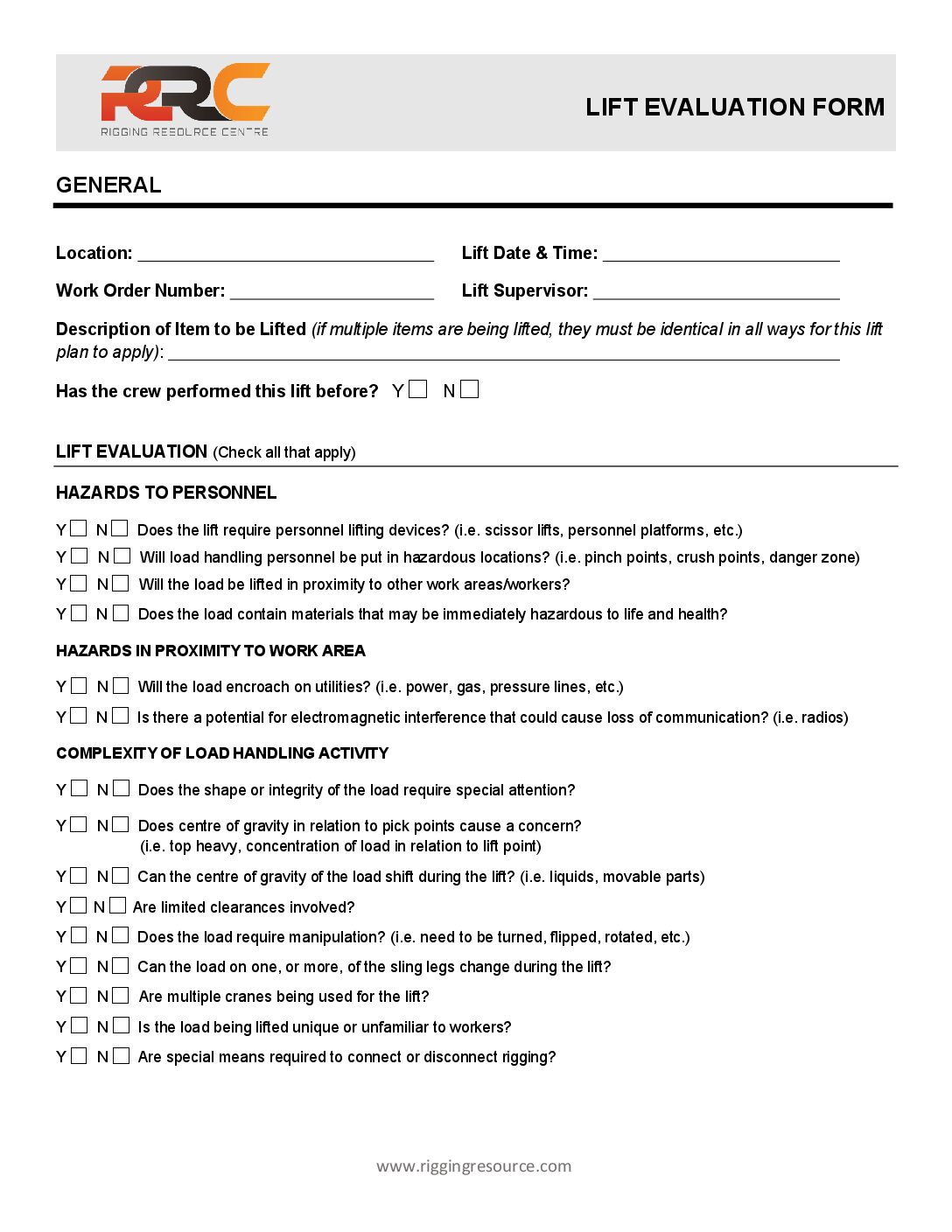
Lift Evaluation Form

The crane operator or lift director can use this sample form to assess and plan a lift prior to moving a load. Click the icon below to download the form.

References

References

Q: All types of inspections must be carried out by a trained and designated person.

True. A person must be trained and designated to carry out inspections on Links and Rings. Refer to ASME B30.26 – Chapter 4.8 Links, Master Links, Subassemblies, Rings and Swivels for general information on the inspection criteria of Links and Rings.False. The horizontal load angle on a Link or Ring should ideally be 60 degrees or greater. Refer to the ASME B30.26 – Chapter 4.9 Links, Master Links, Subassemblies, Rings and Swivels for rigging and operating practices of Links and Rings for more information.

References

Q: The horizontal load angle should not be less than 45 degrees. 

False. The horizontal load angle on a Link or Ring should ideally be 60 degrees or greater. Refer to the ASME B30.26 – Chapter 4.9 Links, Master Links, Subassemblies, Rings and Swivels for rigging and operating practices of Links and Rings for more information.

References

Q: When multiple slings are gathered on a Link or Ring, the included angle must not exceed 120 degrees.

True. The included angle for multiple slings gathered on a Link or Ring must not exceed 120 degrees. Exceeding the 120-degree limit significantly increases the tension on the sling legs and the load on the connection point, overall reducing the lifting capacity. Refer to the ASME Standard B30.26 – Chapter 4.9 Links, Master Links, Subassemblies, Rings and Swivels for detailed information on the rigging practices for Links and Rings. 

References

Q: Periodic inspections of Links and Rings must be carried out monthly.

False. A periodic inspection must be conducted on rigging hardware at minimum once a year. The ASME Standard B30.26 – Chapter 4.8 Links, Master Links, Subassemblies, Rings and Swivels should be referred to for more detailed information on periodic inspection practices for Links and Rings.

References

Q: Links and Rings must always be marked with their size or rated load.

True. Rigging hardware such as Links and Rings must be durably marked with their size or rated load (WLL) by the manufacturer.  For more detailed information, refer to ASME B30.26 – chapter 4.5 Links, Master Links, Subassemblies, Rings and Swivels for specific identification requirements.

References

Q: One cubic foot of solid steel weighs 419 lbs.

False. Steel has a density of  0.284 lbs. per cubic inch, or 490 lbs. per cubic foot.

References

Q: The minimum design factor for Links and Rings is 4:1.

False. The minimum design factor for Links and Rings is generally 5:1. The ASME Standard B30.26 – Chapter 4.2 Links, Master Links, Subassemblies, Rings and Swivels should be referred to for more detailed information on design factors.

References

Q: All Links and Rings must be visually inspected before each use.

True. Links and Rings must be frequently examined visually by a trained and designated person each shift before each use to determine if its condition is fit for service.  Refer to the ASME Standard B30.26 Chapter 4.8 Links, Master Links, Subassemblies, Rings and Swivels for more details on frequent inspection requirements.

References

Q: The rated load/ WLL (Working Load Limit) of a Link or Ring must not be exceeded.

True. The WLL of a Link or Ring must not be exceeded for any reason. Refer to the ASME Standard B30.26 – Chapter 4.1 Links, Master Links, Subassemblies, Rings and Swivels for more detailed information on Link and Ring operating and selection practices.

References

Q: The applicable industry standard to reference for details about Links and Rings is ASME B30.26.

True. Refer to the ASME B30.26-4 Links, Master Links, Subassemblies, Rings and Swivels standard for all applicable information and requirements related to Links and Rings.

Referenced

Q: Periodic inspections of Swivel Hoist Rings must be carried out monthly.

False. A periodic inspection must be conducted on a Swivel Hoist Ring at minimum once a year. Refer to the ASME Standard B30.26 – Chapter 2.8 Adjustable Hardware for more detailed information on periodic inspection practices for Swivel Hoist Rings.

Referenced

Q: Swivel Hoist Rings must always be marked with their Working Load Limit (WLL).

True. All Swivel Hoist Rings must be legibly marked with the Manufacturer’s name or trademark, its Rated Load (WLL), and the Torque value. If the markings are missing or illegible, the device must be removed from service immediately. Refer to the ASME Standard B30.26 – Chapter 2.5 Adjustable Hardware for more information on Swivel Hoist Ring identification.

Referenced

Q: One cubic foot of solid steel weighs 490 lbs.

True. Steel has a density of  0.284 lbs. per cubic inch, or 490 lbs. per cubic foot.

Referenced

Q: The bolt of a Swivel Hoist Ring contains long threads that can be cut to the required length.

False. The bolt of a Swivel Hoist Ring must never be cut or machined. Modifications are prohibited as it significantly impacts the device’s structural integrity. For more details see the ASME B30.26 – Chapter 2.8 Adjustable Hardware for inspection, repair and removal criteria of a Swivel Hoist Ring.

Referenced

Q: Swivel Hoist Rings are designed to rotate under loaded conditions.

True. Swivel Hoist rings are designed to rotate under loaded conditions.  Refer to the ASME Standard B30.26 – Chapter 2.9 Adjustable Hardware for detailed information on the rigging and operating practices of a Swivel Hoist Ring. 

Referenced

Q: The minimum design factor for Swivel Hoist Rings is 6:1.

False. Swivel Hoist Rings must have a minimum design factor of 5:1, which means the breaking strength must be at least five times the rated WLL. For more detailed information, refer to ASME B30.26 – chapter 2.2 Adjustable Hardware for design factor of a Swivel Hoist Ring.

Referenced

Q: Spacers can be used between the Swivel Hoist ring and the load being lifted.

False. Spacers or washers must not be used between the flange of a swivel hoist ring and the surface of a load. This is to ensure proper distribution and stability. Refer to the ASME Standard B30.26 – Chapter 2.9 Adjustable Hardware for more detailed information on rigging and operating practices for Swivel Hoist Rings. 

Referenced

Q: Swivel Hoist Rings must be visually inspected before each use.

True. Swivel Hoist Rings must be visually inspected by a trained and designated person each shift before each use to determine if its condition is fit for service.  Refer to the ASME Standard B30.26 Chapter 2.8 Adjustable Hardware for more details on frequent inspection requirements for Swivel Hoist Rings.

Referenced

Q: The rated load/ WLL (Working Load Limit) of an Eyebolt must not be exceeded.

True. The WLL of a Swivel Hoist Ring must not be exceeded for any reason. Refer to the ASME Standard B30.26 Adjustable Hardware for more detailed information on Swivel Hoist Ring operating and selection practices.

Referenced

Q: The applicable industry standard to reference for details about Swivel Hoist Rings is ASME B30.26.

True. Refer to the ASME B30.26-2 Adjustable Hardware standard for all applicable information and requirements related to Swivel Hoist Rings. 

Referenced

Q: Periodic inspections of Eyebolts must be carried out at least every month.

False. A periodic inspection must be conducted on a Eyebolts at minimum once a year. Refer to the ASME Standard B30.26 – Chapter 2.8 Adjustable Hardware for more detailed information on periodic inspection practices for Eyebolts.

Referenced

Q: One cubic foot of solid steel weighs 490 lbs.

True. Steel has a density of  0.284 lbs. per cubic inch, or 490 lbs. per cubic foot.

Referenced

Q: Eyebolts are not always marked with their WLL (Working Load Limit). 

True. Each Eyebolt must be marked with Manufacturer’s Name or Trademark, Size or Rated Load and Grade for alloy steel eyebolts. For more details see the ASME B30.26 – Chapter 2.8 Adjustable Hardware for inspection, repair and removal criteria of Eyebolts.

Referenced

Q: Shouldered Eyebolts are for in-line loading only.

False. When Shoulder Eyebolts are used for angular loading the shoulder must be flush with and securely tightened against the load. The working load limit (WLL) must be reduced in accordance with the manufacturer’s specifications.  Refer to the ASME Standard B30.26 – Chapter 2.9 Adjustable Hardware for detailed information on the rigging and operating practices of Eyebolts.

Referenced

Q: The minimum design factor for Eyebolts is 3:1.

False. Eyebolts must have a minimum design factor of 5:1, which means the breaking strength must be at least five times the rated WLL. For more detailed information, refer to ASME B30.26 – chapter 2.2 Adjustable Hardware for design factor of Eyebolts.

Referenced

Q: When an Eyebolt is used at an angle its capacity increases.

False. The angle of loading directly influences the stress on the eyebolt; as the angle becomes more horizontal, the stress increases.

Refer to the ASME Standard B30.26 – Chapter 2.9 Adjustable Hardware for more detailed information on rigging and operating practices for Eyebolts.

Referenced

Q: Eyebolts must be visually inspected before each use.

True. Eyebolts must be visually inspected by a trained and designated person each shift before each use to determine if its condition is fit for service.  Refer to the ASME Standard B30.26 Chapter 2.8 Adjustable Hardware for more details on frequent inspection requirements for Eyebolts.

Referenced

Q: The rated load/ WLL (Working Load Limit) of an Eyebolt must not be exceeded.

True. The WLL of an Eyebolt must not be exceeded for any reason. Refer to the ASME Standard B30.26 Adjustable Hardware for more detailed information on Eyebolt operating and selection practices.

Referenced

Q: The applicable industry standard to reference for details about Eyebolts is ASME B30.26.

True. Refer to the ASME B30.26-2 Adjustable Hardware standard for all applicable information and requirements related to Eyebolts.

Referenced

Q: Bolt-type shackles are to be used in long-term installations.

True. Bolt-type shackles are the preferred choice for long-term or semi-permanent installations as the nut and cotter pin act as a secondary retention system that prevents the pin from rotating or unscrewing. Refer to the ASME Standard B30. Shackles for more detailed information on rigging and operating practices involving shackles.

Referenced

Q: Both the body and the pin of the Shackle must be marked with the manufacturer’s identification.

True. The Shackle body and pin is required to be marked with the manufacturer’s identification.  The shackle pin must be from the same manufacturer as the shackle body.  Refer to the ASME Standard B30.26 Shackles for more information on shackle body identification and shackle pin identification.

Referenced

Q: One cubic foot of solid steel weighs 490 lbs.

True. Steel has a density of  0.284 lbs. per cubic inch, or 490 lbs. per cubic foot.

Referenced

Q: A round pin Shackle is the best Shackle to use for angled (side-loaded) lifts. 

False. A round pin Shackle is in fact the worst choice for an angled (side-loaded) lift. Refer to the manufacturer’s specifications for material specifications for side-loading. For more details on shackle types, see the ASME B30.26 Shackles standard.

Referenced

Q: All Shackles have a design factor of 5:1 

False. Shackles up to and including 150 Ton (136 metric ton) have a minimum design factor of 5:1. Shackles over 150 Ton (136 metric ton) have a minimum design factor of 4:1. Refer to the ASME Standard B30.26 – Chapter 1.2 Shackles for more detailed information on design factor allowances.

Referenced

Q: The maximum symmetrical loading between slings on a shackle is 120 degrees.

True. Slings must not exceed a 120-degree included angle when they are symmetrically loaded on the bow of a shackle.

For more detailed information, refer to ASME B30.26 – chapter 1.9 Shackles for operating and rigging practices for Shackles. 

Referenced

Q: When a shackle is ‘side-loaded’ its capacity increases.

False. The opposite is true; when a shackle is ‘side-loaded’ its capacity decreases significantly. Refer to the ASME Standard B30.26 – Chapter 1.9 Shackles for more detailed information on capacity reduction allowances and other rigging practices.

Referenced

Q: Shackles must be visually inspected before each use.

True. Shackles must be visually inspected by a trained and designated person each shift before each use to determine if its condition is fit for service.  Refer to the ASME Standard B30.26 Chapter 1.8 Shackles for more details on frequent inspection requirements.

Referenced

Q: The rated load/ WLL (Working Load Limit) of a Shackle must not be exceeded.

True. The WLL of a Shackle must not be exceeded for any reason. Refer to the ASME Standard B30.26 Shackles for more detailed information on Shackle operating and selection practices.

Referenced

Q: The applicable industry standard to reference for details about shackles is ASME B30.10.

False. Refer to the ASME B30.26-1 Shackles standard for all applicable information and requirements related to Shackles. 

Referenced

Q: The internal fibres (core yarns) of a Polyester Roundsling may be repaired with knots if they were to become cut.

False. Knots are prohibited in any part of the sling. If a Polyester Roundsling were to become damaged or the core yarns cut, the sling must be immediately removed from service. Refer to the ASME Standard B30.9 – Chapter 6.9 Polyester Roundslings for more detailed information on inspection, removal and repair criteria for Polyester Roundslings. 

Referenced

Q: The rated load capacity of a Polyester Roundsling may be reduced if used around small diameters.

True. When used around a small diameter or edge radius, the sling is forced into a sharp bend which increases tension and stress on the internal fibres. This is called “point loading” and may cause the sling to fail. Refer to the ASME Standard B30.9 chapter 6.10 Polyester Roundslings for more information on operating practices and sling selection.  

Referenced

Q: It is acceptable to use a Polyester Roundsling that has holes in its cover as long as the holes are small.

False. A Polyester Roundsling must be removed from service if there are holes, tears or cuts in the cover that expose the internal fibres. Regardless of the size of the holes, the sling becomes vulnerable and can be easily damaged. Refer to the ASME Standard B30.9 – Chapter 6.9 Polyester Roundslings for more detailed information on inspection and removal criteria for Polyester Roundslings. 

Referenced

Q: One cubic foot of solid steel weighs 490 lbs.

True. Steel has a density of  0.284 lbs. per cubic inch, or 490 lbs. per cubic foot.

Referenced

Q: Folding, bunching, or pinching of a Polyester Roundsling is acceptable.

False. It is not acceptable for a Polyester Roundsling to be folded, bunched or pinched. These conditions cause uneven loading across the width of the sling which would significantly reduce the slings rated capacity. Refer to the ASME Standard B30.9 – Chapter 10.4 Rigging Practices for Polyester Roundslings for more detailed information.

Referenced

Q: A Polyester Roundsling can be shortened by tying knots in it.

False. A Polyester Roundsling must never be used if it is knotted or twisted as it can damage the sling and significantly reduce its rated capacity. Refer to the ASME Standard B30.9 – Chapter 6.10 Polyester Roundslings for more detailed information on appropriate operating and rigging practices. 

Referenced

Q: When a Polyester Roundsling is used in a choker hitch, its capacity is based on an angle of choke that is less than 90 degrees.

False. The sling’s capacity is based on an angle of choke that is 120 degrees or greater. Refer to the ASME Standard B30.9 – Chapter 6.10 Polyester Roundslings for more detailed information on appropriate operating practices and sling selection.

Referenced

Q: Polyester Roundslings must be visually inspected every time they are used.

True. Per the Alberta OHS Code Section 294, any rigging that is to be used during a work shift must be thoroughly inspected prior to each period of continuous use by a competent person to ensure it is functional and safe. 

Referenced

Q: The rated load/ WLL (Working Load Limit) of a Polyester Roundsling must not be exceeded. 

True. The WLL of a sling must not be exceeded. Refer to the ASME Standard B30.9 – Chapter 6.10 Polyester Roundslings for more detailed information on the WLL of a Polyester Roundsling.

Referenced

Q: The applicable legislation and standards to reference for details about Polyester Roundslings is Alberta OHS Code 297 and ASME B30.9.

True. The correct Alberta legislation to reference for information on Polyester Roundslings is the Alberta OHS Code section 297. For detailed information on Polyester Roundslings, refer to the ASME B30.9 Slings standard.

Referenced

Q: Synthetic Webbing Slings can be used as bridles on suspended personnel platforms.

False. It is explicitly prohibited to use a Synthetic Webbing Sling as a bridle on a suspended personnel platform. A Wire Rope or Alloy Steel Chain sling is more suited to the task. Refer to the ASME Standard B30.9 – Chapter 5.10 for more detailed information on sling selection and operating practices for Synthetic Webbing Slings. 

Referenced

Q: Ultraviolet (UV) light may negatively affect the capacity of a Synthetic Webbing Sling over time.

True. Ultraviolet (UV) light (from sunlight or welding) degrade the strength of synthetic webbing slings, often without visible indication. Continuous exposure could lead to slight or total degradation of the sling’s load-bearing capacity. Refer to the ASME Standard B30.9 chapter 5.8 for more information on the effects of environment on Synthetic Webbing Slings.  

Referenced

Q: The eye of a Synthetic Webbing Sling may be placed on a hook that has a diameter half the length of the sling eye.

False. The eye of a Synthetic Webbing Sling should not be used with a hook (or any attachment) whose diameter is more than one-third (1/3) of the eye.  If the hook diameter is too large in relation to the eye length it could cause excessive stress on the splices, increase the risk of tearing  and reduce the rated capacity of the sling. Refer to the ASME Standard B30.9 – Chapter 10.4 Synthetic Webbing Slings for more detailed information on rigging practices for Synthetic Webbing Slings. 

Referenced

Q: One cubic foot of solid steel weighs 490 lbs.

True. Steel has a density of  0.284 lbs. per cubic inch, or 490 lbs. per cubic foot.

Referenced

Q: Folding, bunching, or pinching of a Synthetic Webbing Sling is acceptable. 

False. It is not acceptable for a Synthetic Webbing Sling to be folded, bunched or pinched. These conditions cause uneven loading across the width of the webbing which would concentrate stress on a narrow section and significantly reduce the slings rated WLL. Refer to the ASME Standard B30.9 – Chapter 10.4 Rigging Practices for Synthetic Webbing Slings for more detailed information.

Referenced

Q: A Synthetic Webbing Sling must not be used when the horizontal angle is less than 30 degrees. 

True. Refer to the ASME Standard B30.9 – Chapter 10.1 Synthetic Webbing Slings for more detailed information on appropriate operating practices and sling selection. 

Referenced

Q: When a Synthetic Webbing Sling is used in a choker hitch, its capacity is based on an angle of choke angle of less than 90 degrees.

False. The sling’s capacity is based on an angle of choke that is 120 degrees or greater. Refer to the ASME Standard B30.9 – Chapter 10.1 Synthetic Webbing Slings for more detailed information on appropriate operating practices and sling selection. 

Referenced

Q: Synthetic Webbing Slings must be visually inspected every time they are used.

True. Per the Alberta OHS Code Section 294, any rigging that is to be used during a work shift must be thoroughly inspected prior to each period of continuous use by a competent person to ensure it is functional and safe. 

Referenced

Q: The rated load/ WLL (Working Load Limit) of a Wire Rope Sling must not be exceeded. 

True. The WLL of a sling must not be exceeded. Refer to the ASME Standard B30.9 – Chapter 10.1 Synthetic Webbing Slings for more detailed information on the WLL of a Synthetic Webbing Sling. 

Referenced

Q: The applicable legislation and standards to reference for details about Synthetic Webbing Slings is Alberta OHS Code 297 and ASME B30.9.

True. The correct Alberta legislation to reference for information on Synthetic Webbing Slings is the Alberta OHS Code section 297. For detailed information on Synthetic Webbing Slings, refer to the ASME B30.9 Slings standard.

Referenced

Q: Wire Rope Slings should be inspected with bare hands.

False. Wire Rope Slings must be inspected with cautions taken to personnel safety. Damage to wire rope could create sharp edges that could cut or puncture a person’s bare skin. The appropriate cut/puncture resistant gloves should be worn. Refer to the ASME Standard B30.9 – Chapter 10.2 Cautions to Personnel for more detailed information on operating practices for Wire Rope Slings.

Referenced

Q: Wire Rope Slings must be removed from service if they develop ‘bird caging’.

True. A Wire Rope Sling must be permanently removed from service if there is wear over more than one third of the diameter of the rope, if the rope’s structure becomes distorted because of bird-caging,  or if there is evidence of other damage. Refer to the Alberta OHS Code section 306 for more detailed removal criteria on Wire Rope Slings.  

Referenced

Q: Periodic inspections for Wire Rope Slings must be performed, at maximum, every six months. 

False. Periodic inspections must be carried out at least once each year.  Refer to the ASME Standard B30.9 – Chapter 9.4 Wire Rope Slings for more detailed information on periodic inspections for Wire Rope Slings.

Referenced

Q: One cubic foot of solid steel weighs 490 lbs.

True. Steel has a density of  0.284 lbs. per cubic inch, or 490 lbs. per cubic foot.

Referenced

Q: A Wire Rope Sling can only be used if it is marked with its Diameter, WLL and Length.

False. Wire Rope Slings must be marked with the manufacturer’s name or trademark, rated load for specific hitch types/angles, the diameter and the number of legs. Identification tags must be legible. Refer to the ASME Standard B30.9 – Chapter 7.1 Sling Identification for more detailed information on the identification requirements of a Wire Rope Sling. 

Referenced

Q: A Wire Rope Sling must not be used when the horizontal angle is less than 30 degrees. 

True. Refer to the ASME Standard B30.9 – Chapter 10.1 Wire Rope Slings for more detailed information on appropriate operating practices and sling selection when using a Wire Rope Sling. 

Referenced

Q: When a Wire Rope Sling is used in a choker hitch, its capacity is based on an angle of choke of less than 90 degrees.

False. It is based on an angle of choke that is 120 degrees or greater. Refer to the ASME Standard B30.9 – Chapter 10.1 Wire Rope Slings for more detailed information on appropriate operating practices and sling selection when using a Wire Rope Sling. 

Referenced

Q: Wire Rope Slings must be visually inspected every time they are used.

True. Per the Alberta OHS Code Section 294, any rigging that is to be used during a work shift must be thoroughly inspected prior to each period of continuous use by a competent person to ensure it is functional and safe. 

Referenced

Q: The rated load/ WLL (Working Load Limit) of a Wire Rope Sling must not be exceeded.

True. The WLL of a sling must not be exceeded. Refer to the ASME Standard B30.9 – Chapter 10.2 Wire Rope Slings for more detailed information on the WLL of a Wire Rope Sling. 

Referenced

Q: The applicable legislation and standards to reference for details about Wire Rope Slings is Alberta OHS Code 297 and ASME B30.9.

True. The correct Alberta legislation to reference for information on Alloy Steel Chain Slings is the Alberta OHS Code section 297. For detailed information on Alloy Steel Chain Slings, refer to the ASME B30.9 Slings standard. 

Referenced

Q: Periodic inspections for Alloy Steel Chain Slings must be performed, at minimum, once a year.

True. Refer to the ASME Standard B30.9 – Chapter 9-1 Alloy Steel Chain Slings should be referred to for more detailed information on periodic inspections for Alloy Steel Chain Slings. 

Referenced

Q: An Alloy Steel Chain Sling with a missing identification tag can be used as long as you know the chain size and material.

False. A sling missing its identification tag must not be used and immediately removed from service. Refer to the ASME Standard B30.9 – Chapter 9-1 Alloy Steel Chain Slings should be referred to for more detailed information on inspection, removal and repair criteria.

Referenced

Q: One cubic foot of solid steel weighs 360 lbs.

False. Steel has a density of  0.284 lbs. per cubic inch, or 490 lbs. per cubic foot.

Referenced

Q: Personnel must not pass under a suspended load.

True. The Alberta OHS Code section 69 indicates that employers and lifting device operators must ensure that a load does not pass over a person. That includes passing a load over a person as well as a person passing under a suspended load. A load must always travel as low to the ground as possible.  Refer also to the ASME B30.9 Standard on Cautions to Personnel.

Referenced

Q: Performance is based on a temperature range of 0 to 200 degrees Celsius.

False.  The correct answer is -40 to 204 degrees Celsius. Refer to the ASME Standard B30.9 – Chapter 9-1 Alloy Steel Chain Slings should be referred to for more detailed information on the effects of temperature and environment when using an Alloy Steel Chain Sling. 

Referenced

Q: An Alloy Steel Chain Sling must not be used when the horizontal angle is less than 30 degrees. 

True. Refer to the ASME Standard B30.9 – Chapter 9-1 Alloy Steel Chain Slings should be referred to for more detailed information on appropriate operating practices and sling selection when using Alloy Steel Chain Sling. 

Referenced

Q: When an Alloy Steel Chain Sling is used in a choker hitch, its capacity is based on a choke angle of less than 90 degrees.

False. It is based on an angle of choke greater than 120 degrees. Refer to the ASME Standard B30.9 – Chapter 9-1 Alloy Steel Chain Slings should be referred to for more detailed information on appropriate operating practices and sling selection when using Alloy Steel Chain Slings. 

Referenced

Q: Alloy Steel Chain Sling must be visually inspected every time they are used.

True. Per the Alberta OHS Code Section 294, any rigging that is to be used during a work shift must be thoroughly inspected prior to each period of continuous use by a competent person to ensure it is functional and safe.

Referenced

Q: The rated load/ WLL (Working Load Limit) of an Alloy Steel Chain Sling must not be exceeded.

True. The WLL of a sling must not be exceeded. Refer to the ASME Standard B30.9 – Chapter 9-1 Alloy Steel Chain Slings should be referred to for more detailed information on the WLL of an Alloy Steel Chain Sling. 

Referenced

Q: The applicable legislation and standards to reference for details about Alloy Steel Chain Slings is Alberta OHS Code 297 and ASME B30.9

True. The correct Alberta legislation to reference for information on Alloy Steel Chain Slings is the Alberta OHS Code section 297. For detailed information on Alloy Steel Chain Slings, refer to the ASME B30.9 Slings standard. 

Testing Your Knowledge

Comprehensive training is a continuous process that extends beyond initial orientation. To assist in the ongoing education of workers, we have developed a series of short, product-specific quizzes designed to reinforce key safety principles and technical standards. These quizzes serve as an effective self-assessment tool or as a supplementary training resource to ensure that personnel maintain a high level of proficiency when handling rigging equipment. By validating theoretical knowledge alongside practical application, employers can better support a safe, competent, and compliant worksite.

Test your understanding of rigging standards and best practices with our product quizzes below.

Fulfilling Your Responsibility

A toolbox talk (or toolbox meeting) is a short, focused safety discussion held on the worksite to reinforce key hazards, review safe work practices, and address issues relevant to the tasks at hand. It is considered a supplementary form of training because it supports, but does not replace, the formal education and instruction required under Alberta’s Occupational Health and Safety Act, Regulation, and Code.

Alberta legislation requires employers to ensure that workers are competent to perform their jobs safely and are provided with the training, supervision, and information needed to protect their health and safety. Toolbox talks help employers meet these responsibilities by keeping safety knowledge fresh and encouraging regular communication.

They also support workers’ legislated rights to know about hazards, participate in health and safety discussions, and express concerns about unsafe conditions. By involving workers directly in these brief, practical conversations, toolbox talks strengthen shared responsibility and help maintain a safe and informed worksite.

Find an assortment of rigging related toolbox talks ready to be used below.

Quick Reference: Verified Competence

Workers conducting tasks related to rigging must have the knowledge, training, experience, skills and physical ability to conduct the work safely and as required by their employer..  For more information on personal competence, refer to the applicable ASME B30 Standard. 

Per the Alberta OHS Code, a competent person is someone who is trained, qualified and has experience completing rigging tasks safely on their own, without supervision. 

  • Qualified means: someone who has earned their qualifications through a formal education program or acquired them through a combination of education and practical experience.
  • Trained means: training was received that was appropriate to the tasks, equipment and environment in which they will be performed or used.
  • Experienced means: a person has sufficient and adequate knowledge to perform the task with little or no supervision. 

While these are essential components of competence, a worker’s qualifications, training, and experience alone do not guarantee that work will be performed safely each time. It is the employer’s responsibility to conduct training and competency assessments at periodic intervals.

Below are competency evaluation forms that can be used by an employer or supervisor to assess a worker’s competency when conducting tasks involving rigging and rigging equipment.